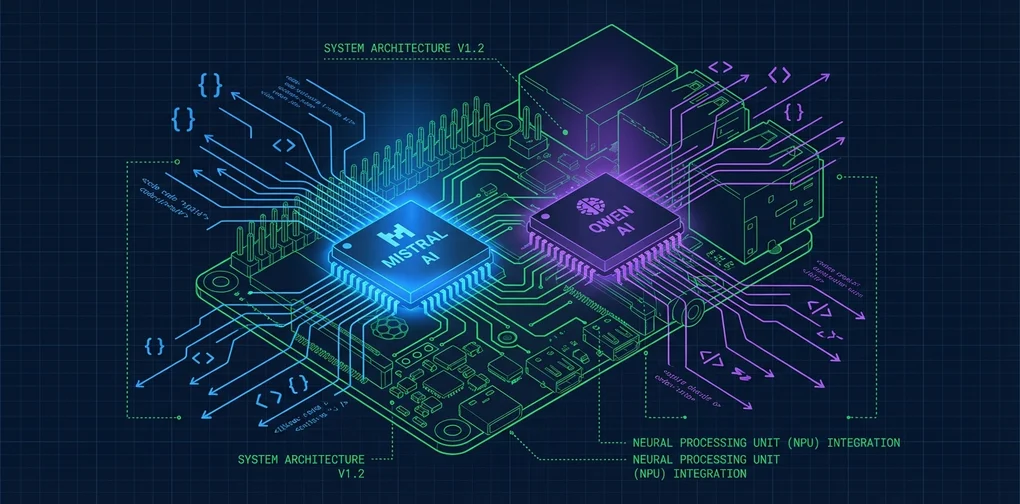
Devstral Small 2 24B & Qwen3 Coder 30B — The Small Coding Model Era Begins
Mistral Devstral Small 2 24B and Qwen3 Coder 30B arrive simultaneously. A comparative analysis of small coding models that run on Raspberry Pi and the future of local AI coding.
Overview
In early 2026, the coding-focused AI model market is undergoing a remarkable shift. Mistral AI’s Devstral Small 2 24B and Alibaba’s Qwen3 Coder 30B have arrived almost simultaneously, ushering in the era of “coding models that run on any hardware.”
These two models aren’t just about being small. They can run on a single RTX 4090 or a Mac with 32GB RAM, yet outperform models with hundreds of billions of parameters in coding tasks. In this article, we compare their architectures, benchmarks, and practical use cases.
Devstral Small 2 24B — Mistral’s Agentic Coding Model
Key Features
Devstral was born from a collaboration between Mistral AI and All Hands AI as a software engineering specialized model.
- Parameters: 24B (Dense model)
- License: Apache 2.0 (fully open source)
- SWE-Bench Verified: 46.8% (open-source SOTA)
- Minimum Hardware: RTX 4090 or Mac with 32GB RAM
- Specialization: Real GitHub issue resolution, agentic coding
Why It Matters
The most remarkable aspect of Devstral is its performance-to-size ratio. It scored higher on SWE-Bench Verified than DeepSeek-V3-0324 (671B) and Qwen3 232B-A22B. Despite being over 20x smaller, its real-world code problem-solving ability is superior.
# Run Devstral with Ollama
ollama pull devstral
ollama run devstral

# Also available on LM Studio
# MLX format for Apple Silicon optimization
What Is Agentic Coding
Devstral focuses not on simple code generation but on agentic coding. This means the model understands the entire codebase, identifies relationships between components, and autonomously resolves complex bugs.
graph LR
    A[GitHub Issue] --> B[Devstral Agent]
    B --> C[Codebase Analysis]
    C --> D[Root Cause Identification]
    D --> E[Fix Code Generation]
    E --> F[Test Execution]
    F --> G[PR Submission]
It operates on top of code agent frameworks like OpenHands or SWE-Agent, automatically resolving GitHub issues without human intervention.
Qwen3 Coder — Alibaba’s Agentic Coding Model
Key Features
Qwen3 Coder is Alibaba’s coding-specialized model series, available in multiple sizes alongside the flagship 480B-A35B.
- Flagship: Qwen3-Coder-480B-A35B (MoE, 35B active parameters)
- Small Variant: Qwen3-Coder-30B-A3B (MoE, 3B active parameters)
- Context: 256K tokens (native), 1M tokens (YaRN extension)
- License: Open source
- Specialization: Agentic coding, browser use, tool calling
Training Innovation
The most notable aspect of Qwen3 Coder’s training is the large-scale application of reinforcement learning (RL).
- Code RL: Large-scale RL on real-world coding tasks rather than competitive programming
- Long-Horizon RL (Agent RL): Long-term RL where the model solves problems through multi-turn tool interactions
- Environment Scaling: 20,000 independent parallel environments on Alibaba Cloud infrastructure
# Qwen3 Coder API usage example
from openai import OpenAI

client = OpenAI(
    api_key="your_api_key",
    base_url="https://dashscope-intl.aliyuncs.com/compatible-mode/v1",
)

# Call the qwen3-coder-plus model
completion = client.chat.completions.create(
    model="qwen3-coder-plus",
    messages=[
        {"role": "system", "content": "You are a helpful coding assistant."},
        {"role": "user", "content": "Find the bug in this function."}
    ],
)
Qwen Code CLI
Alongside Qwen3 Coder, an open-source CLI tool called Qwen Code was released. Forked from Gemini CLI, it features optimized prompts and function calling protocols for Qwen models.
# Install Qwen Code
npm i -g @qwen-code/qwen-code

# Configuration
export OPENAI_API_KEY="your_api_key"
export OPENAI_BASE_URL="https://dashscope-intl.aliyuncs.com/compatible-mode/v1"
export OPENAI_MODEL="qwen3-coder-plus"

# Start coding
qwen
It also supports integration with Claude Code, allowing seamless integration into existing development workflows.
Comparative Analysis
Spec Comparison
| Feature | Devstral Small 2 24B | Qwen3 Coder 30B-A3B |
|---|---|---|
| Parameters | 24B (Dense) | 30B (MoE, 3B active) |
| Architecture | Dense Transformer | Mixture of Experts |
| License | Apache 2.0 | Open source |
| SWE-Bench | 46.8% (verified) | SOTA-class (flagship) |
| Context | Standard | 256K (native) |
| Min VRAM | ~16GB (Q4) | ~4GB (3B active) |
| Runtime | RTX 4090, Mac 32GB | Raspberry Pi capable |
| Agent Frameworks | OpenHands, SWE-Agent | Qwen Code, Claude Code |
Architecture Differences
The biggest difference between the two models is their architecture.
graph TD
    subgraph Devstral["Devstral Small 2 24B (Dense)"]
        D1[All Parameters Active]
        D2[Full 24B Utilized]
        D3[High Inference Accuracy]
    end
    subgraph Qwen3["Qwen3 Coder 30B-A3B (MoE)"]
        Q1[Expert Routing]
        Q2[Only 3B Active Parameters]
        Q3[Low Memory Usage]
end- Devstral: As a Dense model, all 24B parameters participate in inference. It delivers higher accuracy but requires more computational resources.
- Qwen3 Coder 30B-A3B: Using MoE (Mixture of Experts) architecture, only 3B of the 30B parameters are activated per inference. Its extreme memory efficiency makes it viable even on small devices like a Raspberry Pi.
Use Case Recommendations
| Use Case | Recommended Model | Reason |
|---|---|---|
| Local Development (Mac/PC) | Devstral | Higher accuracy, sufficient hardware |
| Edge Devices | Qwen3 Coder | MoE enables ultra-low-spec execution |
| GitHub Issue Automation | Devstral | SWE-Bench verified performance |
| CLI-Integrated Development | Qwen3 Coder | Qwen Code CLI support |
| Privacy-Focused Enterprises | Devstral | Apache 2.0, local execution |
| Long Context Tasks | Qwen3 Coder | 256K native support |
The Future of Local AI Coding
Why Small Coding Models Matter
The emergence of these two models carries significance beyond a simple product launch.
- Privacy: Get AI assistance locally without sending code to external servers
- Cost Savings: Unlimited use on your own hardware without API costs
- Offline Work: Use AI coding assistants without an internet connection
- Customization: Fine-tune on your own codebase to build custom models
Quantization and Optimization
The community is already providing various quantized versions. Calibration datasets specialized for coding models ensure quantization optimized for tool calling and code generation.
# Save VRAM with Q4 quantization
# Devstral: ~16GB → ~8GB
# Qwen3 Coder 30B-A3B: Only 3B active, already ~4GB

# Use quantized models with Ollama
ollama pull devstral:q4_k_m
Developer Ecosystem Changes
As small coding models become mainstream, significant changes in the development tool ecosystem are expected.
graph TD
    A[Small Coding Model Adoption] --> B[IDE-Embedded AI]
    A --> C[CI/CD Pipeline Integration]
    A --> D[Automated Code Review]
    A --> E[Agentic Development Environments]
    B --> F[AI Accessibility for All Developers]
    C --> F
    D --> F
    E --> F
Conclusion
The simultaneous arrival of Devstral Small 2 24B and Qwen3 Coder 30B symbolizes the democratization of coding AI. Without large GPU clusters or expensive API subscriptions, any developer can now run production-grade coding AI on their laptop or even a Raspberry Pi.
What’s particularly noteworthy is that both models adopt different architectures (Dense vs MoE) while pursuing the same goal: “locally executable agentic coding.” This suggests that diverse approaches to small coding models will compete and evolve rapidly.
The era of local AI coding has already begun.
References
Was this helpful?
Your support helps me create better content. Buy me a coffee! ☕
Related Articles
-
GPT-4o Retirement and Model Dependency Risk: Claude Overtakes in Enterprise Market
Covers similar topics in AI/ML, architecture with comparable difficulty.

-
NVIDIA's NVFP4 Cuts LLM Inference Costs by 8x — While Maintaining Accuracy
Covers similar topics in AI/ML, architecture with comparable difficulty.

-
How to Run Qwen3-Coder-Next 80B on 8GB VRAM — Quantization Techniques Explained
Covers similar topics in AI/ML, architecture with comparable difficulty.