Gemini Embedding 2 — How Multimodal Embeddings Change RAG
A deep dive into Google
Why Multimodal Embeddings
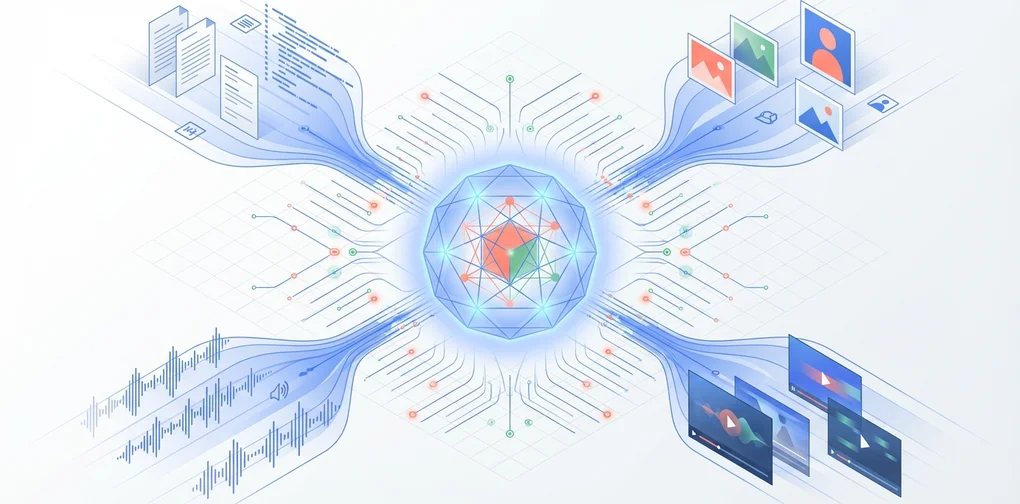
On March 10, 2026, Google announced Gemini Embedding 2 — described as “our first native multimodal embedding model.” It maps text, images, video, audio, and documents into a single vector space.
The biggest limitation of existing RAG pipelines was that they could only handle text. Even when an internal wiki contained diagrams, or a product manual included screenshots, all of that was ignored at the embedding stage. As a result, searches repeatedly failed to surface relevant information despite it being present in the knowledge base.
Gemini Embedding 2 addresses this problem at its root.
Gemini Embedding 2 Key Specs
Input Modalities
| Modality | Coverage | Constraints |
|---|---|---|
| Text | Up to 8,192 tokens | 100+ languages supported |
| Images | Up to 6 per request | PNG, JPEG |
| Video | Up to 120 seconds | MP4, MOV |
| Audio | Native processing | No intermediate text conversion needed |
| Documents | Complex docs like PDFs | Mixed text + image processing |
Output Dimensions
The default output is a 3,072-dimensional vector. The key here is the application of Matryoshka Representation Learning (MRL). Like Russian nesting dolls, information is arranged in a nested structure, so core information is preserved in the higher dimensions even when the dimensionality is reduced.
3072 dimensions (highest precision)
 └── 1536 dimensions (high precision)
      └── 768 dimensions (general purpose)
           └── 256 dimensions (lightweight, mobile/edge)
The reason this matters in practice is that it allows flexible tuning of the cost-accuracy tradeoff. When indexing millions of documents, a two-stage strategy becomes feasible: first-pass filtering with 256 dimensions, then re-ranking top candidates with 3,072 dimensions.
API Access
Two gateways are available:
- Gemini API (AI Studio): For prototyping and individual developers. Includes a free tier.
- Vertex AI (Google Cloud): Enterprise scale. VPC-SC, CMEK, and IAM integration.
Comparison with Existing Embedding Models
Single-Modal vs. Multimodal
graph TD
    subgraph Legacy["Legacy Pipeline"]
        T1["Text Embedding<br/>(text-embedding-3)"] --> VS1["Vector Store"]
        I1["Image Embedding<br/>(CLIP)"] --> VS2["Separate Vector Store"]
        A1["Audio<br/>(Whisper → Text)"] --> T1
    end
    subgraph New["Gemini Embedding 2"]
        T2["Text"] --> GE["Unified Embedding Model"]
        I2["Image"] --> GE
        V2["Video"] --> GE
        A2["Audio"] --> GE
        GE --> VS3["Single Vector Store"]
    end
Three problems with the legacy approach:
- Pipeline complexity: Each modality required a separate model, separate store, and separate retrieval logic
- No cross-modal search: Queries like “find code related to this diagram” were impossible
- Intermediate conversion loss: Converting audio to text lost nuance and context
Embedding Model Spec Comparison
| Model | Modalities | Max Dimensions | MRL | Price (per 1M tokens) |
|---|---|---|---|---|
| OpenAI text-embedding-3-large | Text only | 3,072 | Yes | $0.13 |
| Cohere embed-v4 | Text + Image | 1,024 | Yes | $0.10 |
| Gemini Embedding 2 | Text + Image + Video + Audio | 3,072 | Yes | Free (preview) |
| Voyage AI voyage-3 | Text only | 1,024 | No | $0.06 |
Gemini Embedding 2’s differentiator is clear. It is the only model to natively support all four modalities, with top-tier output dimensions, and is currently free during the preview period.
Practical Application: Building a Multimodal RAG Pipeline
Architecture Design
graph TD
    subgraph Ingestion["Data Ingestion"]
        DOC["Internal Docs<br/>(PDF, Wiki)"]
        IMG["Images<br/>(Diagrams, Screenshots)"]
        VID["Meeting Recordings<br/>(MP4)"]
        AUD["Customer Calls<br/>(Voice)"]
    end
    subgraph Embedding["Embedding Processing"]
        DOC --> GE2["Gemini Embedding 2<br/>API"]
        IMG --> GE2
        VID --> GE2
        AUD --> GE2
    end
    subgraph Storage["Vector Storage"]
        GE2 --> PG["pgvector /<br/>Pinecone /<br/>Weaviate"]
    end
    subgraph Retrieval["Retrieval & Generation"]
        Q["User Query"] --> QE["Query Embedding"]
        QE --> PG
        PG --> RR["Re-ranking"]
        RR --> LLM["Gemini Pro /<br/>Claude"]
        LLM --> ANS["Response"]
    end
Code Example: Python SDK
from google import genai

# Initialize client
client = genai.Client(api_key="YOUR_API_KEY")

# Text embedding
text_result = client.models.embed_content(
    model="gemini-embedding-exp-03-07",
    contents=["Key clauses from the internal security policy document"],
    config={
        "output_dimensionality": 768,  # Reduce dimensions via MRL
        "task_type": "RETRIEVAL_DOCUMENT"
    }
)
print(f"Text vector dimensions: {len(text_result.embeddings[0].values)}")
# Output: Text vector dimensions: 768

# Image embedding (same vector space)
from google.genai import types

image = types.Part.from_uri(
    file_uri="gs://my-bucket/architecture-diagram.png",
    mime_type="image/png"
)
image_result = client.models.embed_content(
    model="gemini-embedding-exp-03-07",
    contents=[image]
)

# Cosine similarity between text and image vectors is now possible
import numpy as np

def cosine_similarity(a, b):
    return np.dot(a, b) / (np.linalg.norm(a) * np.linalg.norm(b))

similarity = cosine_similarity(
    text_result.embeddings[0].values,
    image_result.embeddings[0].values
)
print(f"Text-image similarity: {similarity:.4f}")
Task Type Strategy
Gemini Embedding 2 lets you specify the embedding purpose using the task_type parameter:
| Task Type | Purpose | Use Case |
|---|---|---|
RETRIEVAL_DOCUMENT | Document indexing | When storing RAG documents |
RETRIEVAL_QUERY | Query encoding | When processing user search queries |
SEMANTIC_SIMILARITY | Similarity comparison | Duplicate detection, clustering |
CLASSIFICATION | Classification | Automatic document classification, labeling |
CLUSTERING | Clustering | Topic modeling, grouping |
Pro tip: Always use different task types for indexing and retrieval. Using RETRIEVAL_DOCUMENT when storing documents and RETRIEVAL_QUERY when querying significantly improves asymmetric retrieval performance.
EM/CTO Perspective: Adoption Considerations
1. Pipeline Simplification = Reduced Operational Costs
The most direct benefit of adopting multimodal embeddings is reduced pipeline complexity.
If you currently operate separate embedding pipelines per modality:
- 3–4 models → 1 model
- 2–3 vector stores → 1 vector store
- Synchronization logic eliminated
- Fewer systems to monitor
According to Google’s official blog, some customers have achieved 70% latency reduction.
2. Vendor Dependency Assessment
Gemini Embedding 2 is currently Google-exclusive. For organizations running a multi-cloud strategy:
- Abstract the embedding layer: Design the embedding model as a swappable interface
- Vector format compatibility: 3,072-dimension vectors are compatible with most vector databases
- Leverage MRL: Dimension reduction makes it possible to match dimensions with other models
3. Data Governance
Sending multimodal data to an external API introduces governance considerations:
- On Vertex AI, VPC Service Controls can define data perimeters
- CMEK (Customer-Managed Encryption Keys) is supported
- PII masking is recommended before embedding meeting recordings and customer call audio
- If Data Residency requirements apply, confirm region selection carefully
4. Cost Model Forecasting
The model is currently free during preview, but billing is expected after GA. Cost optimization strategy:
Indexing:     256 dimensions (MRL)  → 87% storage cost reduction vs. 3072
First pass:   256-dim ANN search    → fast and inexpensive
Re-ranking:   3072-dim exact match  → top 50 candidates only
This two-stage strategy simultaneously optimizes cost and accuracy at the scale of millions of documents.
Production Migration Checklist
When transitioning from a text-only RAG to a multimodal RAG:
- Data inventory: Assess the current state of non-text data in your organization (images, video, audio)
- Prioritization: Apply multimodal indexing first to document types with the highest search failure rate
- Vector DB compatibility: Confirm your existing vector store supports 3,072 dimensions (pgvector, Pinecone, and Weaviate all do)
- A/B testing: Quantitatively compare retrieval accuracy between existing text-only and multimodal embeddings
- Monitoring: Track cross-modal search rate, latency, and embedding API call volume
- Security review: Obtain security and compliance approval for external transmission of multimodal data
Conclusion
Gemini Embedding 2 is not simply “a new embedding model.” It is a paradigm shift in RAG pipeline architecture.
Search systems that could previously only handle text can now perform unified retrieval across images, video, and audio within the same vector space. This is not just a technical advancement — it is a change that can fundamentally transform how organizations leverage unstructured data.
Key action items from an Engineering Manager’s perspective:
- Now: Run a PoC using the Gemini API during the preview period (free)
- Within 1–2 weeks: Create an inventory of non-text data within your organization
- Within 1 month: Design an A/B test comparing multimodal RAG against your existing RAG pipeline
References
Was this helpful?
Your support helps me create better content. Buy me a coffee! ☕
Related Articles
-
AI Agent KPI Pressure and Ethics Violations — What 12-Model Testing Reveals About Goal-Driven AI
Covers similar topics in AI/ML, architecture with comparable difficulty.

-
CCC vs GCC — How Good Is an AI-Written C Compiler, Really?
Covers similar topics in AI/ML, architecture with comparable difficulty.

-
Anthropic's Big AI Ecosystem Play — Institute & $100M Fund
Covers similar topics in AI/ML, architecture with comparable difficulty.