GPT-5.4 Launch — Native Computer Use and 1M Context Window Will Transform Engineering Teams
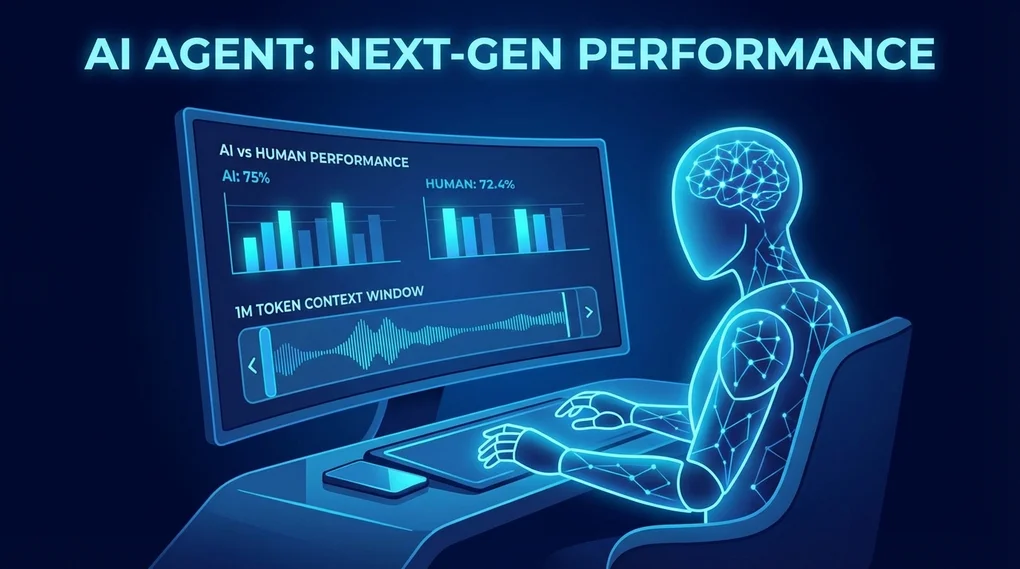
OpenAI released GPT-5.4 on March 5, 2026. Computer use surpassing humans (75% vs 72.4% on OSWorld), 1M token context window, 47% token savings via tool search — here's what engineering managers need to know.
Why GPT-5.4 Is Different
On March 5, 2026, OpenAI officially released GPT-5.4. This isn’t a routine version bump. It’s the first general-purpose model to combine three capabilities simultaneously: native Computer Use, a 1M token context window, and tool search.
Where GPT-5.2 demonstrated scientific discovery in theoretical physics, and GPT-5.3 exposed platform reliability concerns during the Codex rollout pause, GPT-5.4 signals that AI agents have arrived at a level where they can genuinely work.
3 Core Upgrades
1. Native Computer Use — Surpassing Human Performance
GPT-5.4 achieves 75.0% on the OSWorld-Verified benchmark. Here’s the comparison:
| Model / Baseline | OSWorld Score |
|---|---|
| GPT-5.4 | 75.0% |
| Human baseline | 72.4% |
| Claude Opus 4.6 | 74.7% (Terminal-Bench 2.0) |
| Gemini 3.1 Pro | 78.4% (Terminal-Bench 2.0) |
| GPT-5.2 | 47.3% |
GPT-5.4 can directly manipulate real computer environments through screenshots, mouse movements, and keyboard inputs. It autonomously executes website navigation, file management, and multi-step workflows across software systems.
In the API, GPT-5.4 integrates with Codex, incorporating Codex’s cutting-edge coding capabilities while extending to a general-purpose agent that also handles spreadsheets, presentations, and document work.
2. 1M Token Context Window
The largest context window in OpenAI’s history. Long-context benchmark performance:
- 0〜128K range: Graphwalks BFS 93.0%
- 256K〜1M range: 21.4% (extremely challenging zone)
What does 1M tokens mean in practice? An entire repository codebase, hundreds of customer support logs, years of project documentation — all processable within a single context. For the first time, multi-step agents have sufficient context capacity to plan, execute, and verify tasks across long operational horizons.
3. Tool Search — 47% Token Reduction
In traditional MCP setups, tool schemas are injected on every turn as the number of active tools grows. On Scale’s MCP Atlas benchmark (36 MCP servers, 250 tasks), GPT-5.4’s tool search achieved:
- 47% reduction in total token usage
- Accuracy maintained
Tool search enables agents to dynamically discover tools on demand rather than injecting all schemas upfront. Cost savings are particularly significant in large enterprise MCP environments.
GPT-5.4 Thinking vs Pro
This release ships in two variants.
GPT-5.4 Thinking: Outlines its plan before responding. Users can intervene mid-task to redirect if the AI misses a key detail. Transparency and control increase substantially for complex multi-step tasks.
GPT-5.4 Pro: High-performance optimized version. Excels at professional knowledge work — spreadsheet modeling, document parsing, and presentation design.
EM Perspective: What Changes for Your Team
Large-Scale Automation of Repetitive Tasks
The fact that computer use ability has surpassed human-level performance means that legacy GUI-based workflows can now be realistically automated. Internal systems without APIs, GUI-based admin panels, spreadsheet operations — agents can operate these directly.
Context Engineering Paradigm Shift
Agent architectures designed around 128K expand to 1M. Instead of complex RAG pipelines, simply “putting everything needed into context” becomes a realistic option. However, be aware that accuracy in the 256K〜1M range (21.4%) remains limited.
Tool Cost Optimization
As MCP server counts grow, the value of tool search increases. If your enterprise environment runs 30+ MCP servers, introducing tool search alone could cut API costs nearly in half.
Competitive Landscape Monitoring Required
On Terminal-Bench 2.0, Gemini 3.1 Pro (78.4%) outperforms GPT-5.4 in certain areas. Model selection must consider specific task types and cost structures, not just a single benchmark metric.
Action Items
First, list your current GUI-based internal processes that haven’t been automated. These are the first candidates for computer use agents.
Second, identify tasks that genuinely need 1M context. The question isn’t just whether context is long, but whether long context is actually advantageous in terms of accuracy and cost for specific cases.
Third, if your MCP server count exceeds 10, evaluate introducing tool search. A 47% token reduction is a number you can’t ignore.
Closing Thoughts
GPT-5.2 showed us “AI doing science.” GPT-5.3 revealed “AI platform reliability management” as a critical discipline. GPT-5.4 announces that “AI agents are working in real computer environments.”
Computer use ability surpassing human performance, context windows large enough for entire codebases, cost savings for large-scale MCP deployments — all three axes are entering production simultaneously.
For engineering managers, the directive is clear: identify right now which workflows in your team should change first as this wave arrives.
Was this helpful?
Your support helps me create better content. Buy me a coffee! ☕
Related Articles
-
GPT-5.3 Codex Rollout Pause — GitHub/VSCode Platform Reliability Analysis
Analyzes issues with previous GPT-5 versions, essential for understanding GPT-5.4 context.

-
GPT-5.2 Derives New Result in Theoretical Physics — The Turning Point Where AI Becomes a Discoverer
Shows the progression of the GPT-5 series, best read alongside this post.

-
Context Engineering: The Core Skill Behind Production AI Agents
Deep dive into how to leverage large context windows in production agents.