What I Want to Tell Juniors in the Age of AI
Career advice from years of SMB experience. How domain knowledge and T-shaped growth can help you thrive in the AI era.
Why I’m Writing This
I’m not anyone special. I haven’t worked at a Big Tech company, and I don’t have a glamorous career path to show off. What I do have is years of experience working in small and medium-sized businesses (SMBs), and I think that perspective might be helpful to some of you navigating your careers right now.
Recently, I had the opportunity to give a 3-minute speech at my alumni reunion. Standing in front of students about to enter the workforce and recent graduates just starting their careers, I shared some thoughts on surviving and thriving in the age of AI. This post expands on what I said that day.
This isn’t a lecture. It’s more like a conversation I wish I could have with every junior developer, designer, or product person who’s wondering what their career will look like in this rapidly changing landscape.
The Reality of Working in Small Companies
Let me be honest about what it’s like working in SMBs.
In a small company, you don’t get the luxury of specialization. You’re not “just” a frontend developer or “just” a product manager. One day you’re writing code, the next you’re sitting in on customer calls, and by Friday you’re helping out with marketing materials because that’s what the team needs.
This has two sides to it.
On one hand, it can feel scattered. You might look at your peers at larger companies who are deeply specialized in one thing—becoming experts in React performance optimization, or machine learning infrastructure, or growth marketing—and wonder if you’re falling behind. That’s a real concern. Depth of expertise matters.
On the other hand, there’s something valuable that happens when you’re forced to see the bigger picture. You start understanding how different parts of a business connect. You see the pain points that other teams face. You learn to think about problems from multiple angles.
And in the AI era we’re entering, I’m starting to believe this breadth might matter more than we think.
What’s Actually Changing Right Now
The numbers don’t lie. Large companies are cutting headcount. Entry-level hiring has dropped significantly. The easy explanation is “economic downturn,” but I think there’s more to it.
The truth is simpler and more uncomfortable: AI can do what a mid-level specialist does, faster, without getting tired, and often better.
I’m not saying this to scare you. I’m saying it because we need to face it directly.
If your main value proposition is “I can write clean React components” or “I can analyze this dataset,” you’re in a vulnerable position. Not because you’re not good at those things, but because AI is getting really good at them too. And AI doesn’t need health insurance or vacation days.
So How Do We Stay Relevant?
Here’s what I’ve been thinking about a lot lately: domain knowledge.
What do I mean by that? Let me give you a concrete example.
Let’s say you’re a frontend developer working on an e-commerce platform. The obvious thing to focus on is getting really good at frontend development—learning the latest frameworks, understanding performance optimization, mastering CSS animations.
But what if you also started paying attention to how the inventory system works? What challenges does the operations team face when products go out of stock? How does the customer service team handle returns? What friction points do users experience during checkout that don’t show up in your analytics?
This is where a Japanese concept called 思いやり (omoiyari) comes in. It’s often translated as “empathy” or “consideration,” but it’s deeper than that. It’s about actively trying to understand someone else’s situation and thinking about how you might help them, even when it’s not your direct responsibility.
When you approach your work with omoiyari—genuinely trying to understand the full domain you’re working in—something interesting happens. You start seeing connections. You notice inefficiencies that no one else spots because you’re one of the few people who understands both the technical side and the business context.
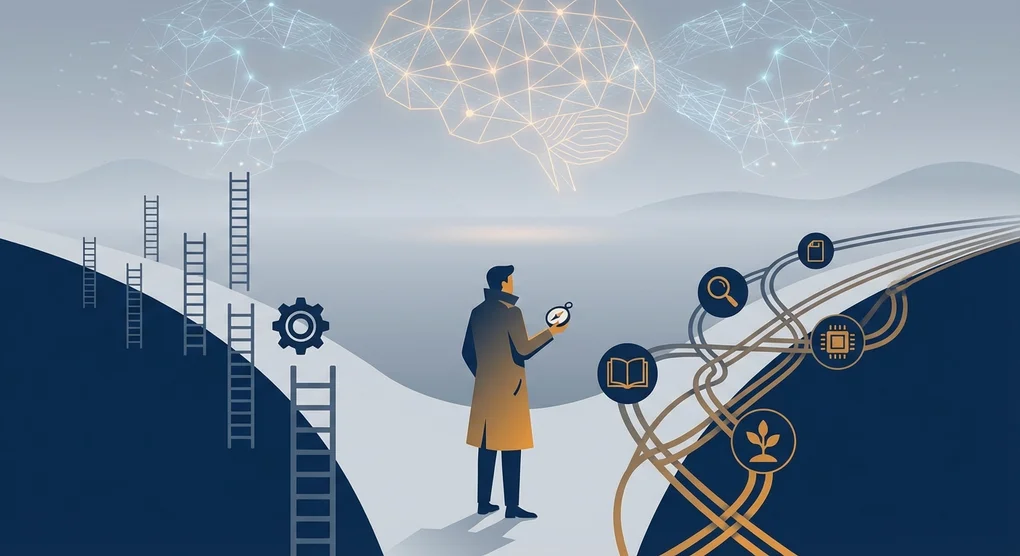
You become what people call a “T-shaped” professional: deep knowledge in one area (the vertical part of the T) combined with broad understanding across related domains (the horizontal part).
Why This Matters More Now
Here’s the thing about AI: it’s really good at executing tasks when you can clearly define what needs to be done. It can write code, analyze data, create designs—all at an impressive level.
But it struggles with something that T-shaped humans are good at: connecting dots across domains that AI doesn’t even know exist.
AI doesn’t sit in the support team meeting and hear about the same customer complaint coming up five times in a week. It doesn’t notice that the marketing team’s biggest pain point could be solved with a small technical change. It doesn’t understand the unspoken dynamics of how different departments interact.
The people who will thrive in the AI era aren’t necessarily the ones who are the absolute best at one narrow thing. They’re the ones who can:
- Understand business context deeply - not just their own role
- Identify problems worth solving - across organizational boundaries
- Use AI as a powerful tool - to execute solutions they’ve envisioned
Think of it this way: AI is like having an incredibly capable assistant who can do almost anything you ask for, as long as you know what to ask for. The skill that matters is knowing what to ask for—and that comes from domain knowledge and cross-functional understanding.
Practical Steps You Can Take
If you’re early in your career, here are some concrete things you can do:
1. Talk to other teams
Don’t just stay in your bubble. Have coffee (virtual or real) with someone from sales, customer success, operations, whatever. Ask them about their challenges. You’re not trying to solve them immediately—just listen and understand.
2. Volunteer for cross-functional projects
When there’s a project that spans multiple teams, raise your hand. Yes, it might be messy and ambiguous. That’s the point. You’re building that horizontal bar of your T.
3. Use AI aggressively in your current role
Don’t wait for permission. Start using Claude, ChatGPT, or whatever AI tools make sense for your work. Learn what they’re good at and where they fall short. This hands-on experience is invaluable.
4. Document and share what you learn
When you figure something out—whether it’s a technical solution or a cross-team insight—write it down and share it. This does two things: it solidifies your own understanding, and it makes you visible as someone who thinks beyond their immediate tasks.
5. Be genuinely curious about the business
If you work for a company, try to understand how it actually makes money. What are the unit economics? What do customers actually pay for? What would make the business 10x more valuable?
The Hard Truth
I won’t sugarcoat it: this is a tough market for junior professionals. Companies are hiring fewer people. The bar for entry-level positions has gone up. It feels unfair because it kind of is—you’re entering the workforce at a moment of significant transition.
But here’s what I’m also seeing: there are companies actively looking for people who combine domain knowledge with AI fluency. They’re not just hiring for specific technical skills. They’re hiring for people who can think about problems holistically and use all available tools—including AI—to solve them.
These opportunities might not be at the biggest, flashiest companies. They might be at smaller companies, or in industries you haven’t considered, or in roles that don’t have traditional job titles. But they exist.
What I Really Want You to Know
If there’s one thing I want you to take away from this, it’s this:
Don’t try to compete with AI on AI’s terms. You will lose that race.
Instead, develop the uniquely human skill of understanding context, connecting disparate pieces of knowledge, and caring about problems beyond your job description. That quality of omoiyari—thoughtful consideration for the bigger picture—combined with the willingness to use AI as a powerful tool, is what will set you apart.
The AI era isn’t about humans versus machines. It’s about humans who understand how to work with machines versus humans who don’t.
Choose to be in the first group.
A Final Word
Your career won’t look like mine, and it definitely won’t look like someone who started their career 10〜15 years ago. The path is different now, and that’s okay.
What doesn’t change is this: people who genuinely care about solving real problems, who take the time to understand the full picture, and who stay curious and adaptable—those people always find a way.
I’m rooting for you.
頑張ってください (Ganbatte kudasai - Do your best).
Was this helpful?
Your support helps me create better content. Buy me a coffee! ☕
Related Articles
-
What Happens When You Assign Gender and Personas to AI Agents?
Suitable as a next-step learning resource, connecting through AI/ML topics.

-
OpenAI AgentKit Complete Guide Part 1: Core Concepts and Getting Started
Covers similar topics in AI/ML with comparable difficulty.

-
Build a RAG System in 5 Minutes with Google Gemini File Search
Suitable as a next-step learning resource, connecting through AI/ML topics.