Deep-Thinking Ratio: Cut LLM Inference Costs by 50%
Google & UVA research overturns the "longer = better" assumption for LLM reasoning. The Deep-Thinking Ratio (DTR) can cut inference costs in half while improving accuracy.
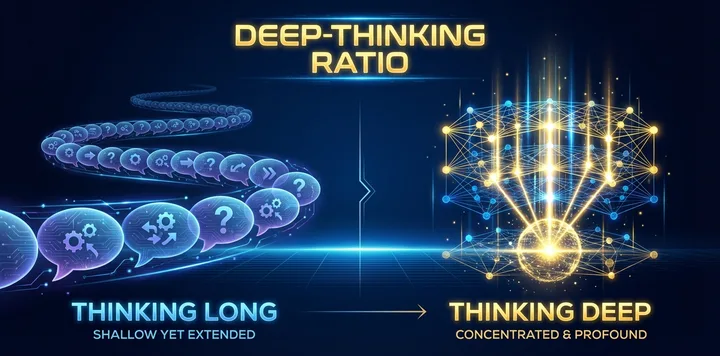
The “Longer = Better” Assumption Was Wrong
For the past few years, the LLM reasoning world operated on a simple axiom: the longer your Chain-of-Thought, the more accurate your answer. This principle underpins the design of o1, o3, and Claude’s Extended Thinking — more tokens equal higher quality. It became industry orthodoxy.
In February 2026, researchers from the University of Virginia and Google published a paper that directly challenges this assumption: “Think Deep, Not Just Long: Measuring LLM Reasoning Effort via Deep-Thinking Tokens” (arXiv:2602.13517). Their alternative: the Deep-Thinking Ratio (DTR).
What Is the Deep-Thinking Ratio?
Core Concept: Measuring Reasoning Depth
DTR measures the proportion of tokens in a reasoning sequence where genuine deep processing occurs.
A Deep-Thinking Token is one where the model’s predictions undergo significant revision between early (shallow) layers and late (deep) layers. In other words, these are the tokens where the model actually “thinks harder” before settling on an output.
DTR = (Deep-Thinking Tokens) / (Total Reasoning Tokens)Length vs. Depth: The Correlation Data
The research team tested 22 models including GPT-4o, Claude 3.7, Gemini 2.5 Pro, and o4-mini-high.
| Metric | Correlation with Accuracy | Interpretation |
|---|---|---|
| Reasoning Length (token count) | r = -0.59 | Negative correlation — longer often means worse |
| DTR (reasoning depth ratio) | r = +0.683 | Strong positive correlation — deeper means better |
The implication is clear: long reasoning chains are often a symptom of “overthinking”, and can actually be inversely related to output quality.
Think@n: The DTR-Based Cost Reduction Algorithm
The research team proposes a practical algorithm called Think@n that applies DTR to eliminate wasteful computation.
How It Works
1. Begin generating n reasoning candidates in parallel
2. Generate only the first 50 tokens of each candidate
3. Calculate DTR for each 50-token prefix
4. Immediately terminate candidates with low DTR
5. Continue generating only the high-DTR candidates to completion
The key insight: just 50 tokens is enough to determine whether a reasoning path is “thinking deeply.”
Results: AIME 25 Benchmark
On the AIME 2025 benchmark (challenging math problems), Think@n delivered:
Standard Voting (baseline):
  - Accuracy: baseline
  - Cost: 100%

Think@n:
  - Accuracy: higher than baseline
  - Cost: ~51% (49% reduction)
This isn’t just a cost trade-off. Think@n achieves higher accuracy at half the cost.
Practical Implications for Engineering Managers and VPoEs
1. Rethink Your Token Budget Policy
Most teams today operate on “more context, more tokens = better results.” DTR research shows this assumption can be fundamentally wrong.
Concrete actions to consider:
- Differentiate task types: Identify which tasks genuinely require deep reasoning vs. which don’t. Stop applying maximum token budgets uniformly.
- Implement early stopping logic: Build pipelines that can detect low-DTR signals and terminate reasoning early.
- Parallel generation + filtering: Kick off multiple reasoning paths simultaneously, but cut the underperformers after 50 tokens.
2. AI Agent Pipeline Redesign
For AI agents doing complex reasoning, DTR becomes a powerful optimization lever.
# Conceptual implementation
def think_at_n(problem, n_candidates=5, prefix_length=50):
    candidates = []

    # Initialize n reasoning paths
    for i in range(n_candidates):
        prefix = generate_tokens(problem, max_tokens=prefix_length)
        dtr = calculate_dtr(prefix)
        candidates.append((prefix, dtr))

    # Filter by DTR: keep only top performers
    threshold = median([c[1] for c in candidates])
    promising = [c for c in candidates if c[1] >= threshold]

    # Complete only the promising candidates
    results = [complete_generation(c[0]) for c in promising]
    return best_of(results)
3. Expand Your Cost Monitoring Metrics
Traditional AI cost monitoring focuses on token counts and API call volumes. DTR opens up a new dimension:
| Existing Metric | DTR-Enhanced Version |
|---|---|
| Total token count | Deep-thinking vs. shallow-thinking token ratio |
| Response length | Quality-per-token ratio |
| API cost | Cost proportional to actual reasoning effort |
Current Limitations of DTR
Applying DTR in production today has several constraints worth acknowledging:
1. Requires access to model internals DTR requires access to intermediate layer hidden states. This information isn’t exposed through commercial APIs like GPT-4o or Claude today.
2. Immediately applicable with open-source models Teams deploying Llama 3.1, Qwen 3, Mistral, or other open-source models can implement DTR-based optimization right now.
3. Awaiting vendor support Longer term, expect Anthropic, OpenAI, and Google to either adopt DTR-based optimization at the API layer or expose reasoning efficiency metrics as part of their offerings.
Actionable Insights You Can Apply Today
Even without direct DTR calculation via commercial APIs, the research offers immediate practical takeaways:
Stop equating token length with reasoning quality. Simply raising max token limits is likely costing you money without improving results. Real-world LLM API cost experiments confirm this same pattern.
Experiment with Best-of-N strategies now. The core idea behind Think@n — start multiple paths, quickly abandon the unpromising ones — can be implemented today using other heuristics like confidence scores or perplexity in place of DTR.
Diversify your reasoning approaches. For complex tasks, multiple independent short reasoning chains may outperform a single long one. Test this in your domain before assuming longer is better.
Conclusion
DTR represents a genuine paradigm shift in how we measure and optimize LLM reasoning — from “think longer” to “think deeper.” For engineering leaders managing AI infrastructure, the bottom line is compelling: there’s now a theoretical and empirical foundation for cutting inference costs in half while improving accuracy.
If your team is running open-source models, you have everything you need to start experimenting with DTR-based optimization today. And if you’re on commercial APIs, watch for vendor adoption in the coming months. Paired with the declining trajectory of AI training costs, inference efficiency optimization is becoming the next real competitive edge.
References
Read in Other Languages
Related Articles
-
Karpathy: AI Training Costs Drop 40% Per Year
Both focus on LLM cost optimization; reading DTR alongside training cost reduction strategies gives a holistic view of AI cost strategy.
-
AI Agent Cost vs Human Labor: A Honest Analysis from Running 8 Agents
Covers the reality of AI agent operational costs, directly connecting to DTR strategies for reducing inference costs.
-
ASIC Inference Chip Runs Llama 3.1 8B at 16,000 tok/s
Compare hardware (ASIC) approaches to inference speed with DTR's software-level cost reduction strategy.