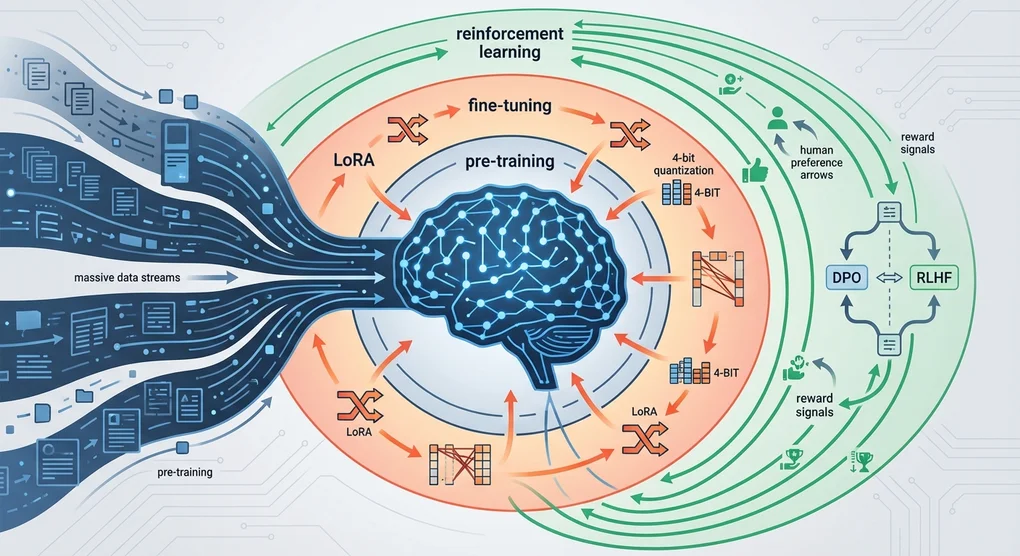
DeNA LLM Study Part 3: Model Training Methodologies - From Pre-training to RLHF/DPO
Deep dive into pre-training, fine-tuning, and reinforcement learning based on DeNA LLM study materials Part 3, exploring efficient techniques like LoRA, QLoRA, and DPO.
Series: DeNA LLM Study (3/5)
- Part 1: LLM Fundamentals and 2025 AI Landscape
- Part 2: Structured Output and Multi-LLM Pipelines
- Part 3: Model Training Methodologies ← Current Article
- Part 4: RAG Architecture and Latest Trends
- Part 5: Agent Design and Multi-Agent Orchestration
Introduction
DeNA’s LLM study materials Part 3 covers diverse learning methodologies for LLMs. We’ll explore the differences between pre-training, fine-tuning, and reinforcement learning, and examine the principles and practical applications of cutting-edge efficient training techniques like LoRA, QLoRA, and DPO.
This post is based on DeNA’s study materials, enhanced with 2025 trends and hands-on experience.
Pre-training vs Fine-tuning vs Reinforcement Learning
Understanding Through Restaurant Analogy
DeNA materials explain the three learning approaches through a restaurant operation metaphor:
graph TD
    A[Pre-training<br/>Pre-training] --> B[Fine-tuning<br/>Fine-tuning]
    B --> C[Reinforcement Learning<br/>RLHF/DPO]

    A1[Chef Basic Training<br/>Learn All Cuisines] --> A
    B1[Specific Restaurant<br/>Menu Specialization] --> B
    C1[Customer Feedback<br/>Taste Improvement] --> C
Pre-training
- Purpose: Acquire general language understanding capabilities
- Data: Tens to hundreds of TBs of web data
- Cost: Hundreds of millions to billions of dollars (GPT-4 estimated $100B+)
- Analogy: Learning all cooking techniques in culinary school
Fine-tuning
- Purpose: Specialize for specific tasks/domains
- Data: Thousands to tens of thousands of task-specific examples
- Cost: Hundreds to thousands of dollars
- Analogy: Becoming a pasta specialist at an Italian restaurant
Reinforcement Learning
- Purpose: Generate responses aligned with human preferences
- Data: Thousands to tens of thousands of preference pairs
- Cost: Thousands to tens of thousands of dollars
- Analogy: Adjusting dish flavors based on customer feedback
Practical Decision-Making Guide
graph TD
    Start[Need LLM Training?] --> Q1{New Knowledge<br/>Required?}
    Q1 -->|Yes| PreTrain[Pre-training<br/>Cost: Very High]
    Q1 -->|No| Q2{Task-Specific<br/>Needed?}
    Q2 -->|Yes| FineTune[Fine-tuning<br/>Cost: Medium]
    Q2 -->|No| Q3{Preference<br/>Alignment?}
    Q3 -->|Yes| RL[Reinforcement Learning<br/>Cost: Medium]
    Q3 -->|No| Prompt[Prompt Engineering<br/>Cost: Low]
Decision Checklist:
- Can it be solved with prompts? → Try prompt optimization first
- Does the existing model understand the task? → Yes: RL, No: Fine-tuning
- Is it a completely new domain? → Consider pre-training (but watch costs)
PEFT: The Rise of Efficient Fine-tuning
Problems with Traditional Fine-tuning
Limitations of Full Fine-tuning that updates all parameters:
- Memory Usage: Fine-tuning a 7B model requires 80GB+ VRAM
- Time Cost: Takes hours to days
- Deployment Challenges: Need to store entire model per task (tens of GBs)
Core Idea of PEFT
Parameter-Efficient Fine-Tuning (PEFT) maximizes efficiency by training only a subset of parameters:
graph TD
    subgraph Traditional_Fine-tuning
        A[Original Model<br/>7B Parameters] --> B[Full Update<br/>7B Parameters]
        B --> C[New Model<br/>28GB Storage]
    end

    subgraph PEFT
        D[Original Model<br/>7B Parameters] --> E[Add Few Parameters<br/>Millions]
        E --> F[Store Adapter Only<br/>Under 10MB]
    end
Major PEFT Methods:
- Adapter: Insert small networks between layers
- Prefix Tuning: Add trainable prefixes to inputs
- LoRA: Update via low-rank decomposition (most popular)
- Prompt Tuning: Train only soft prompts
LoRA: Principles of Low-Rank Adaptation
Mathematical Background
LoRA (Low-Rank Adaptation) is based on the following mathematical insight:
# Original weight update (Full Fine-tuning)
W_new = W_original + ΔW  # ΔW is d×d size

# LoRA's low-rank decomposition
ΔW = B @ A  # B is d×r, A is r×d (r << d)

# Practical application
output = (W_original + B @ A) @ input
Core Idea:
- Pre-trained weights already contain abundant information
- The change amount (ΔW) needed for fine-tuning has low intrinsic dimensionality
- Therefore, ΔW can be expressed as the product of two small matrices (B, A)
LoRA Hyperparameter Configuration Guide
# LoRA configuration example (HuggingFace PEFT)
lora_config:
  r: 8 # Rank (intrinsic dimension)
  lora_alpha: 16 # Scaling parameter
  lora_dropout: 0.1 # Dropout rate
  target_modules: # Layers to apply
    - q_proj # Query projection
    - v_proj # Value projection
  bias: "none" # Whether to train bias
Hyperparameter Selection Guide:
| Parameter | Recommended | Description |
|---|---|---|
| r (Rank) | 4〜16 | Smaller saves memory, larger increases expressiveness. 8 works for most cases |
| lora_alpha | r〜2r | Acts like learning rate. Usually 1〜2x of r |
| lora_dropout | 0.05〜0.1 | Prevents overfitting. Set higher for small datasets |
| target_modules | q_proj, v_proj | Query/Value in Attention are most effective |
LoRA Variants
DoRA (Weight-Decomposed Low-Rank Adaptation, 2024)
# DoRA: Decompose weights into magnitude and direction
W = m * (V + B @ A)
# m: trainable magnitude, V: normalized weights, B@A: LoRA- Advantage: Performance closer to Full Fine-tuning
- Disadvantage: Slightly slower than LoRA
GaLore (Gradient Low-Rank Projection, 2024)
# Project gradient to low-rank space to save memory
gradient_lowrank = project_to_lowrank(gradient)
optimizer.step(gradient_lowrank)- Advantage: Compress optimizer states too → 50% additional memory savings
- Disadvantage: High implementation complexity
LoRA+ (2024)
# Apply different learning rates to matrices A and B
lr_A = lr * eta  # Higher learning rate for A
lr_B = lr # Default learning rate for B- Advantage: 1.5〜2x convergence speed improvement
- Disadvantage: Requires hyperparameter tuning
QLoRA: Combining Quantization with PEFT
Innovation of 4-bit Quantization
QLoRA combines 4-bit quantization with LoRA to dramatically reduce memory usage:
graph TD
    subgraph Memory_Comparison
        A[Original 16bit<br/>14GB] --> B[8bit Quantization<br/>7GB]
        B --> C[4bit QLoRA<br/>3.5GB]
    end

    subgraph Performance_Retention
        D[Full Fine-tuning<br/>100%] --> E[LoRA<br/>98%]
        E --> F[QLoRA<br/>97%]
    end
QLoRA Core Technologies:
- 4bit NormalFloat (NF4): Quantization optimized for normal distributions
- Double Quantization: Quantize quantization constants too
- Paged Optimizers: Automatic CPU-GPU memory management
QLoRA Practical Workflow
from transformers import AutoModelForCausalLM, BitsAndBytesConfig
from peft import LoraConfig, get_peft_model

# 1. 4-bit quantization configuration
bnb_config = BitsAndBytesConfig(
    load_in_4bit=True,
    bnb_4bit_quant_type="nf4",      # NormalFloat 4bit
    bnb_4bit_compute_dtype="float16", # Compute in float16
    bnb_4bit_use_double_quant=True,   # Double quantization
)

# 2. Load model
model = AutoModelForCausalLM.from_pretrained(
    "meta-llama/Llama-2-7b-hf",
    quantization_config=bnb_config,
    device_map="auto"  # Automatic device allocation
)

# 3. LoRA configuration
lora_config = LoraConfig(
    r=8,
    lora_alpha=16,
    target_modules=["q_proj", "v_proj"],
    lora_dropout=0.1,
    bias="none",
    task_type="CAUSAL_LM"
)

# 4. Create PEFT model
model = get_peft_model(model, lora_config)

# 5. Check trainable parameters
trainable_params = sum(p.numel() for p in model.parameters() if p.requires_grad)
print(f"Trainable parameters: {trainable_params:,} ({trainable_params/7e9*100:.2f}%)")
# Output: Trainable parameters: 4,194,304 (0.06%)
QLoRA Practical Tips:
- GPU Memory: Train 7B model on single RTX 3090 (24GB)
- Batch Size: Use gradient accumulation (e.g., batch_size=1, gradient_accumulation_steps=16)
- Training Time: 1.5〜2x slower than Full Fine-tuning (quantization overhead)
RLHF and DPO: Learning Human Preferences
Complexity of RLHF
Reinforcement Learning from Human Feedback (RLHF) is powerful but complex:
graph TD
    A[1. Train SFT Model<br/>Supervised Fine-tuning] --> B[2. Train Reward Model<br/>Reward Model]
    B --> C[3. Optimize Policy with PPO<br/>Proximal Policy Optimization]

    D[Human Preference Data<br/>A vs B Comparison] --> B
    B --> E[Reward Score Prediction]
    E --> C

    C --> F[Final Aligned Model<br/>Aligned Model]
RLHF Problems:
- 3-stage Pipeline: SFT → Reward Model → RL Optimization
- Instability: PPO is sensitive to hyperparameters
- High Cost: Reward model training + RL sampling
- Difficult Debugging: Hard to diagnose RL convergence failures
DPO: Direct Preference Optimization
Direct Preference Optimization (DPO) learns human preferences directly without a reward model:
graph TD
    A[Human Preference Data<br/>Preferred vs Rejected] --> B[DPO Loss Function<br/>Classification Loss]
    B --> C[Aligned Model<br/>Single-stage Training]

    D[RLHF: 3 Stages] -.-> E[SFT → Reward → PPO]
    F[DPO: 1 Stage] -.-> C
DPO Loss Function:
# DPO Loss (simplified formula)
loss = -log(σ(β * (log π(y_w|x) - log π(y_l|x))))

# y_w: Preferred response (chosen)
# y_l: Rejected response (rejected)
# β: Hyperparameter (typically 0.1)
# σ: Sigmoid function
DPO Advantages:
- Simplicity: No reward model needed, single training stage
- Stability: Classification loss is more stable than PPO
- Efficiency: 50% reduction in memory and time
- Performance: Equal or better performance than RLHF
DPO Practical Implementation
from trl import DPOTrainer

# DPO training configuration
training_args = TrainingArguments(
    output_dir="./dpo_model",
    per_device_train_batch_size=4,
    learning_rate=5e-5,
    num_train_epochs=3,
    gradient_accumulation_steps=4,
)

# Initialize DPO Trainer
dpo_trainer = DPOTrainer(
    model=model,
    args=training_args,
    train_dataset=preference_dataset,  # (prompt, chosen, rejected) format
    tokenizer=tokenizer,
    beta=0.1,  # DPO hyperparameter
)

# Run training
dpo_trainer.train()
Preference Data Format:
preference_dataset = [
    {
        "prompt": "How to sort a list in Python?",
        "chosen": "Use the sorted() function: sorted([3,1,2])",
        "rejected": "Just use sort()"
    },
    # ...
]
DPO Variants
ORPO (Odds Ratio Preference Optimization, 2024)
- Performs SFT and preference learning simultaneously
- No separate SFT stage needed
- Further training time reduction
IPO (Identity Preference Optimization, 2024)
- Can train without reference model
- Further memory reduction
KTO (Kahneman-Tversky Optimization, 2024)
- Uses individual feedback (good/bad) instead of pairwise comparisons
- Drastically reduced data collection costs
Task-Specific Training Method Selection Guide
Cost-Performance Tradeoff
graph TD
    A[Analyze Task Type] --> B{General<br/>Knowledge OK?}
    B -->|Yes| C[Prompt Engineering<br/>Cost: $0]
    B -->|No| D{Domain-Specific<br/>Needed?}

    D -->|Yes| E{Data Size}
    E -->|Small| F[Few-shot ICL<br/>Cost: $0]
    E -->|Medium| G[LoRA/QLoRA<br/>Cost: $10~100]
    E -->|Large| H[Full Fine-tuning<br/>Cost: $1,000~10,000]

    D -->|No| I{Response Quality<br/>Improvement?}
    I -->|Yes| J[DPO/ORPO<br/>Cost: $100~1,000]
Practical Recommendations
1. Chatbots/Conversational Systems
Prompt → SFT (LoRA) → DPO- Domain knowledge injection: Efficient fine-tuning with LoRA
- Dialogue quality improvement: Preference alignment with DPO
2. Document Classification/Tagging
Prompt → LoRA (Optional)- Usually sufficient with prompts
- Add LoRA for extreme performance needs
3. Code Generation
Prompt → SFT (QLoRA) → RLHF/DPO- Code style learning: Train on large code corpus with QLoRA
- Executability improvement: Penalize compilation errors with RLHF
4. Summarization/Translation
Prompt → DPO- Base model often sufficient
- Style adjustment: Learn desired tone/length with DPO
Memory Requirements Comparison
| Method | 7B Model | 13B Model | 70B Model |
|---|---|---|---|
| Full Fine-tuning | 80GB | 160GB | 800GB+ |
| LoRA | 40GB | 80GB | 400GB |
| QLoRA | 24GB | 40GB | 200GB |
Consumer GPU Viability:
- RTX 4090 (24GB): Can train 7B with QLoRA, 3B with LoRA
- RTX 3090 (24GB): Can train 7B with QLoRA
- RTX 4060 Ti (16GB): Can train 3B with QLoRA
Insights and Reflections
Democratization of LLM Fine-tuning
The most impressive aspect of DeNA materials was that LLM fine-tuning is no longer exclusive to large corporations. With the advent of QLoRA and DPO:
- Fine-tune 7B models with 24GB VRAM
- Build domain-specific models on hundreds of dollars budget
- Use simple DPO instead of complex RLHF
Paradigm Shift in Efficiency
Recently, Efficiency has become a trending topic:
- LoRA: 98% of Full Fine-tuning performance with 0.1% parameters
- QLoRA: Same performance with 1/4 memory
- DPO: Equal performance with 1/3 of RLHF complexity
This isn’t just optimization but the result of novel mathematical insights. Low-rank hypotheses, quantization theory, implicit reward models—academic research is rapidly transitioning to practice.
Lessons for Practitioners
- Start with prompts: 80% can be solved with prompts
- LoRA as default: Try LoRA first when fine-tuning is needed
- Save resources with QLoRA: Minimal performance difference, 4x memory savings
- Align with DPO: RLHF is legacy, DPO is the new standard
- Measure and improve: Focus on actual task performance over benchmark scores
2025 Outlook
Expected trends:
- Smaller yet powerful models: Rise of compact models like Phi-3, Gemma 2
- On-device fine-tuning: Era of fine-tuning on smartphones
- Automated hyperparameter tuning: AutoML for LLM Fine-tuning
- Multimodal PEFT: Simultaneous image+text fine-tuning
References
Papers
- LoRA: Low-Rank Adaptation of Large Language Models (Microsoft, 2021)
- QLoRA: Efficient Finetuning of Quantized LLMs (University of Washington, 2023)
- Direct Preference Optimization (Stanford, 2023)
- DoRA: Weight-Decomposed Low-Rank Adaptation (NVIDIA, 2024)
- GaLore: Memory-Efficient LLM Training (CMU, 2024)
Libraries
- HuggingFace PEFT - LoRA, QLoRA implementation
- HuggingFace TRL - RLHF, DPO implementation
- Unsloth - 2x faster LoRA training
Tutorials
Coming Next: “DeNA LLM Study Part 4: Production Deployment and Monitoring” will cover strategies for deploying fine-tuned models to actual services, monitoring methods, and cost optimization techniques.
Was this helpful?
Your support helps me create better content. Buy me a coffee.
Related Articles
-
Verbalized Sampling: A Training-Free Prompting Technique to Restore LLM Diversity
Covers similar topics in AI/ML, architecture with comparable difficulty.

-
Analyzing Blog Revisit Intent with SSR Methodology
Covers similar topics in AI/ML with comparable difficulty.

-
DeNA LLM Study Part 2: Structured Output and Multi-LLM Composition Patterns
Covers similar topics in AI/ML, architecture with comparable difficulty.